 Pulisi
Technical Deep Dive: Molecular Properties of Sodium Sulfide ($Na_2S$)
An authoritative engineering whitepaper analyzing crystalline behaviors, industrial grade parameters, and global supply dynamics.
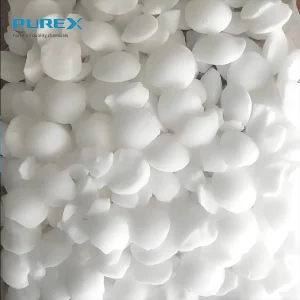
Sodium Sulfide ($Na_2S$) is a fundamental inorganic compound recognized as an essential catalyst, reducing agent, and precipitant across multiple manufacturing sectors. In its anhydrous state, it is a white crystalline solid, but it most commonly exists in the market as yellow or red flakes. This coloration is a direct indicator of its chemical composition, representing the hydrated states—primarily sodium sulfide nonahydrate ($Na_2S \cdot 9H_2O$) and pentahydrate ($Na_2S \cdot 5H_2O$). The technical specifications of these variants are critical for plant managers, metallurgical engineers, and procurement departments looking to optimize reaction metrics and yield rates.
Critical Chemical & Physical Parameters
Understanding the exact thermodynamics and reaction profile of Sodium Sulfide ensures safety and material optimization. Below is the official analytical profile detailing the typical chemical characteristics of industrial-grade sodium sulfide flakes:
| Property Parameter | Standard Specification (Yellow Flakes) | Low-Iron Grade (Premium Flakes) | Test / Verification Method |
|---|---|---|---|
| Sodium Sulfide ($Na_2S$) Content | $60.0\% \text{ Min}$ | $60.0\% \text{ Min}$ | GB/T 10500-2009 Titration |
| Iron ($Fe$) Concentration | $\le 150 \text{ ppm}$ | $\le 10 \text{ ppm}$ / $\le 30 \text{ ppm}$ | Atomic Absorption Spectroscopy |
| Sodium Carbonate ($Na_2CO_3$) | $\le 2.0\%$ | $\le 1.5\%$ | Acid-base titration limit tests |
| Water Insolubles | $\le 0.20\%$ | $\le 0.05\%$ | Gravimetric Analysis |
| Physical Appearance | Yellowish crystalline flakes | Light yellow to transparent flakes | Visual Assessment |
Chemical Behavior and Reaction Pathways
In aqueous solution, Sodium Sulfide undergoes rapid hydrolysis, forming a highly alkaline mixture rich in sodium hydrosulfide ($NaHS$) and sodium hydroxide ($NaOH$). The reaction is represented as follows:
Na₂S + H₂O ⇌ NaHS + NaOH
This dissociation is highly exothermic and demands strict storage conditions to prevent ambient humidity absorption. When exposed to acids, sodium sulfide reacts violently, liberating toxic and highly flammable hydrogen sulfide gas ($H_2S$). Consequently, facility layouts must maintain isolated storage areas, separating $Na_2S$ from acidic feedstocks and oxidizing agents. Dry storage under inert nitrogen blankets is highly recommended for bulk silos.